About
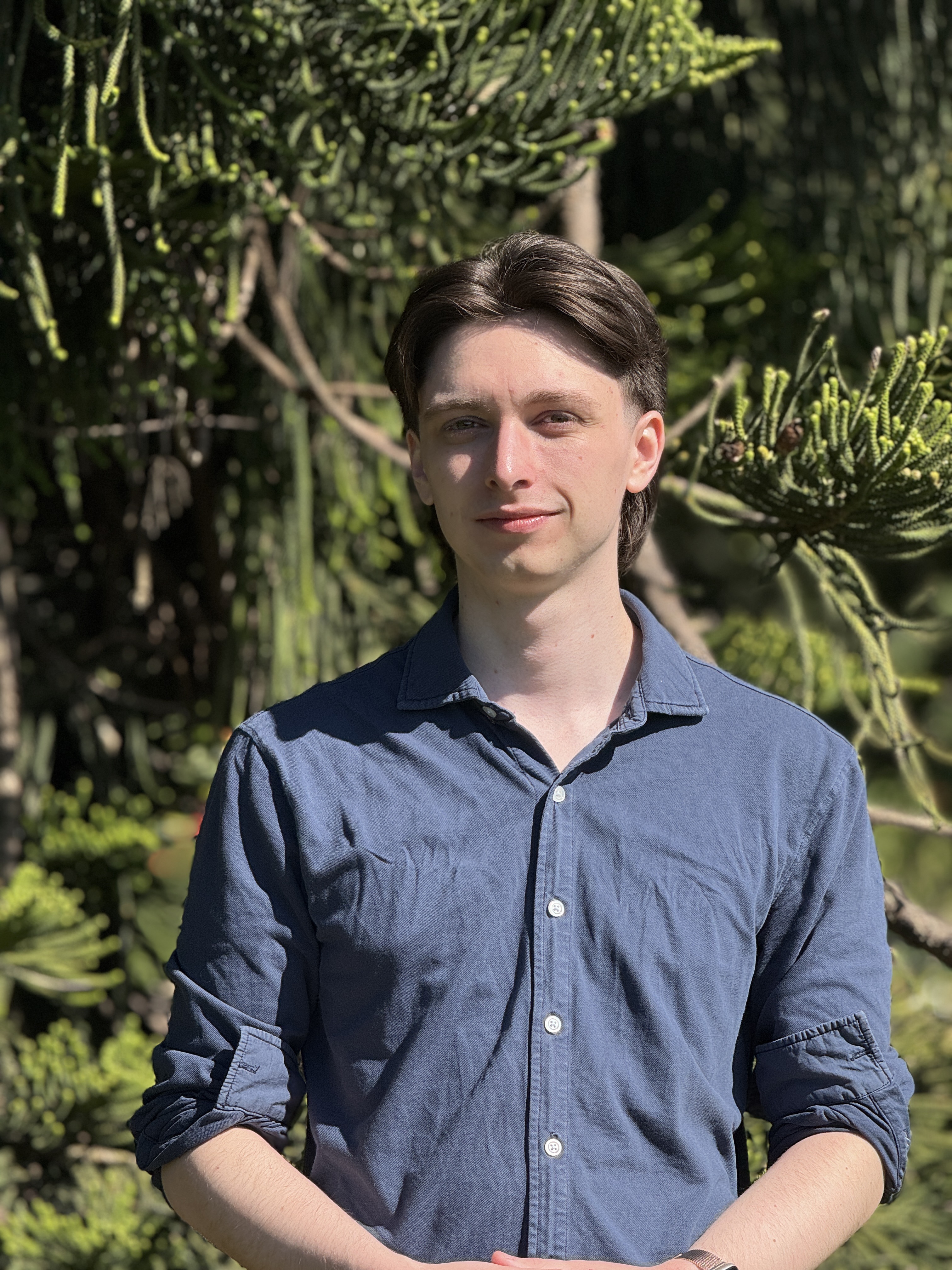
I'm Nicholas Astill, a composer focusing on polystylistic compositional approaches and cultural pluralism in music creation. As a composer, researcher, and digital creator originally specialising in electroacoustic music, I now bring that perspective to my acoustic/instrumental writing. I aim to crystallise new compositional directions through active, plural aesthetic explorations in my compositional practice, which I achieve via the analytical framework developed in my research. My first orchestral work, Mutations, was premiered by the Melbourne Symphony Orchestra for its 2026 First Voices Showcase.
I'm currently undertaking a PhD in music composition and technology at Sydney Conservatorium of Music, supervised by Benjamin Carey and Damien Ricketson. Additionally, I work part-time at the conservatorium, tutoring introductory composition and musicology. I also work at the Australian Music Centre, where I assist with the maintenance of the library and database, as well as preparing and processing music resources.
Outside music, I'm a commissioned visual artist, using digital “found document collage” and algorithmic transformation, creating artwork used by projects such as Backstage Music's AZIMUTH: Navigating Sound and Space.
I'm a Kamilaroi man, which is something I approach quite deeply in my artistic and personal life. Sometimes you can see this in my work, but not always. I've written extensively on this subject and my relationship with art and identity here.
Selected works
Research
The goal of my research is to identify connections between seemingly disparate music aesthetics and ideas, surfacing non-obvious compositional directions and opportunities for further musicological research. Through corpora analysis using contemporary natural language processing, I spend much of my research time reconciling the technical details with the messy textual manifestations of human knowledge.
The main portion of my research project is the creation of a system for navigating a learned embedding space of musicological knowledge coupled with a polystylistic creative practice developed and informed by that navigation. Unlike the dominant audio-centric approach in AI music, this system operates at the level of musicological concepts and their relationships, providing the composer a structured space of creative affordances rather than generated output. The embedding space is derived from a semantically enriched graph neural network trained on Wikipedia's musicological corpus, in which musical concepts are positioned according to learned relational proximity. The user experience consists of a two-stage exploratory spatial navigation view, with investigative tooling. LocalMAP dimensionality reduction provides macroscopic orientation within the space, while high-dimensional distance metrics supply local precision, identifying non-obvious conceptual proximities. These proximities become compositional directions, enriching polystylistic practice by surfacing unexpected musicological connections.